
Call us now
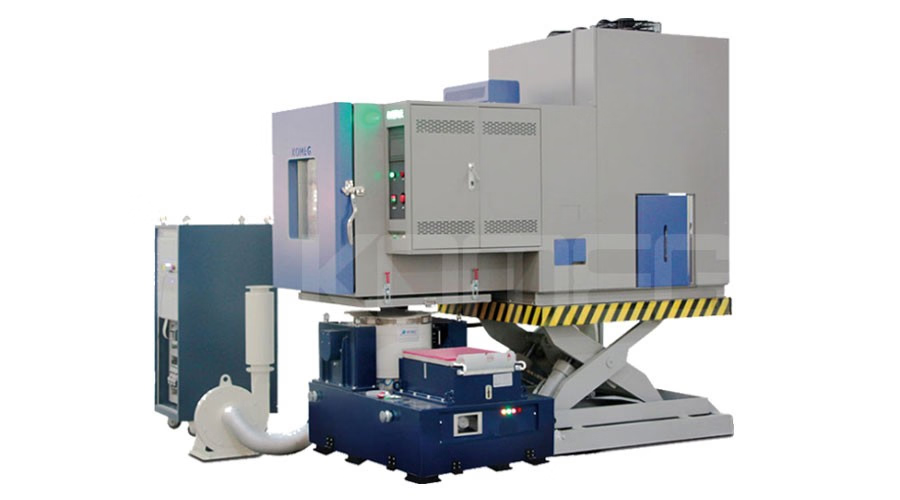
The Temperature-Humidity-Vibration Combined Test System is an advanced reliability testing platform that integrates climatic stress with mechanical vibration. By combining a high-performance environmental chamber with an electrodynamic or mechanical shaker, this system allows you to simulate the complex, multi-dimensional stresses that products face in real-world operating environments. It is engineered specifically to identify synergistic failure modes that single-stress tests might miss, making it an indispensable tool for safety screening and durability validation of critical assemblies.
Aerospace Sector: Evaluates the performance of aircraft components under temperature, humidity, and vibration conditions.
Electronics and Communications Industry: Conducts comprehensive testing on electronic components and communication equipment to assess their reliability in diverse environments.
Materials Science: Assists researchers in investigating changes in the physical and chemical properties of materials under varying environmental conditions, providing data support for new material development.
Automotive Manufacturing: Simulates the environmental conditions automotive components encounter in diverse climates and road conditions to evaluate their durability and reliability.
GB/T 2423.35 Procedures for combined temperature, humidity, and vibration testing, including environmental condition setting and performance monitoring
GB/T 28046.3 Focuses on automotive electrical and electronic systems, classifying severity by component installation location (e.g., engine, body) to simulate actual operating environments
GB/T 44279-2024 Covers combined temperature-humidity-vibration-low-pressure testing, enhancing simulation capabilities for extreme environments (e.g., high altitude or tropical climates)
IEC 60068-2-53 Test methods for electrical and electronic products under combined temperature, humidity, and vibration environments, emphasizing accelerated exposure of product failure modes through multi-stress superposition
ISO 16750-3 Prescribes coordinated testing of mechanical loads (vibration) and temperature conditions for automotive electronic equipment, ensuring component durability during vehicle operation
1. Simultaneously simulate multiple environmental factors: Capable of concurrently simulating temperature, humidity, and vibration to more closely replicate actual product usage conditions, enhancing test accuracy.
2. Accelerates exposure of potential product defects: Through stress superposition, it expedites the manifestation of latent design flaws, manufacturing imperfections, or premature component failures, providing evidence for design enhancements.
3. Cost savings: Reduces equipment investment and testing space requirements, thereby lowering R&D and testing expenses.
| Item | Specification |
|---|---|
| Temperature Range | -60C +150C |
| Temperature Change Rate | 5C/min (with load), average over the range of -40C to 100C |
| Temperature Deviation | 2C (no load, steady state) |
| Temperature Uniformity | 2C (no load, steady state) |
| Temperature Fluctuation | 0.5C (no load, steady state) |
| Humidity Range | 20% R.H. 98% R.H. |
| Humidity Deviation | +2% R.H. -3% R.H. (when >75% R.H.), 5% R.H. (when 75% R.H.) |
Sample Preparation: Develop test protocols based on product type (e.g., electronic components or metal parts) and record baseline data.
Environmental Simulation: Simultaneously apply temperature (-70C to 150C), humidity (10%-98% RH), and vibration stress within the test chamber using a multi-channel closed-loop control system.
Intermediate Inspection: Conduct visual inspections, dimensional measurements, and electrical tests at critical test phases (e.g., temperature peaks), comparing before-and-after data.
Data Analysis: Evaluate specimen responses, identify failure modes (e.g., resonance or material aging), and compile detailed reports.

Price:


 Send Inquiry

 Send Inquiry
 Send Inquiry